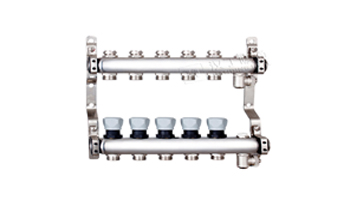
As an important part of modern comfortable homes, floor heating achieves heating effects by circulating low-temperature hot water in pipes to evenly heat the floor. As the heart of the system, the floor heating manifold undertakes the core functions of hot water distribution and reflux collection.
Preparation before installation
1. List of materials and tools
Core materials: floor heating manifold, PERT/PEX floor heating pipe, insulation board, reflective film, cardin, boundary insulation strip, aluminum foil tape, etc.
Auxiliary tools: hot melt machine, pressure gauge, tape measure, level, impact drill, pipe cutter, wrench.
2. Site survey and design planning
Confirm the location of the heat source: the heat source needs to be close to the manifold, shorten the length of the main pipeline to reduce heat loss.
Plan the pipeline direction: avoid the pipeline passing through the door and under the fixed furniture, and ensure that the length of each loop is balanced.
Mark the installation location of the manifold: usually located on the non-load-bearing wall of the kitchen, bathroom or balcony for easy operation and maintenance.
Installation Steps
1. Ground treatment
Remove debris, repair cracks, and ensure that the ground is clean and dry. Install boundary insulation strips to offset concrete expansion.
2. Lay insulation layer
Lay extruded board with a thickness of ≥2cm to reduce heat loss downward. Use aluminum foil tape to seal the joints to prevent heat leakage.
3. Lay reflective film
Cover the insulation layer, and the aluminum foil reflective film needs to overlap 5cm and fix it with tape. Mark the pipeline direction area to avoid fixed furniture positions.
4. Install water distributor and main pipeline
Install filters and valves at the water inlet of the water distributor. Connect the main pipeline to the heat source and reserve an inspection port.
5. Lay floor heating pipeline
Coil according to the design drawing, with uniform spacing and fixed with staples. The length of a single circuit is ≤100 meters to avoid hydraulic imbalance. Install expansion joints at the door to prevent cracking of the ground.
6. Install temperature control system
For water heating, install an electric valve at the water distributor and connect it to the room temperature controller.
Floor heating provides quiet, even heating, but requires careful planning. For hydronic systems, manifolds are essential for balanced heat distribution.Underfloor heating provides quiet, even heating, but requires careful planning. For hydronic systems, the UNDERFLOOR HEATING MANIFOLD is essential for balanced heat distribution